Article Summary
Drawing on insights from the Health Spaces x FORTIS roundtable, Aligning Estate Decisions with Evolving Care Pathways, this article explores what it really takes to move care closer to home. As community and technology-enabled models become central to NHS reform, the discussion asks whether new settings and tools are enough, or whether a deeper rethink is needed.
The shift from hospital to community has become one of the defining ambitions of NHS reform. It is easy to understand why. Acute hospitals are under sustained pressure, demand continues to rise, and many patients are still being seen in settings that are neither convenient for them nor clinically necessary.
Across the system, there is growing recognition that care needs to move closer to people’s homes, supported by better use of technology, more integrated services and a more preventative approach to health. Yet the central challenge is not whether the direction of travel is right. It is how the NHS can ensure that new settings and technologies support genuine changes in the model of care, rather than simply moving existing pressures into different places.
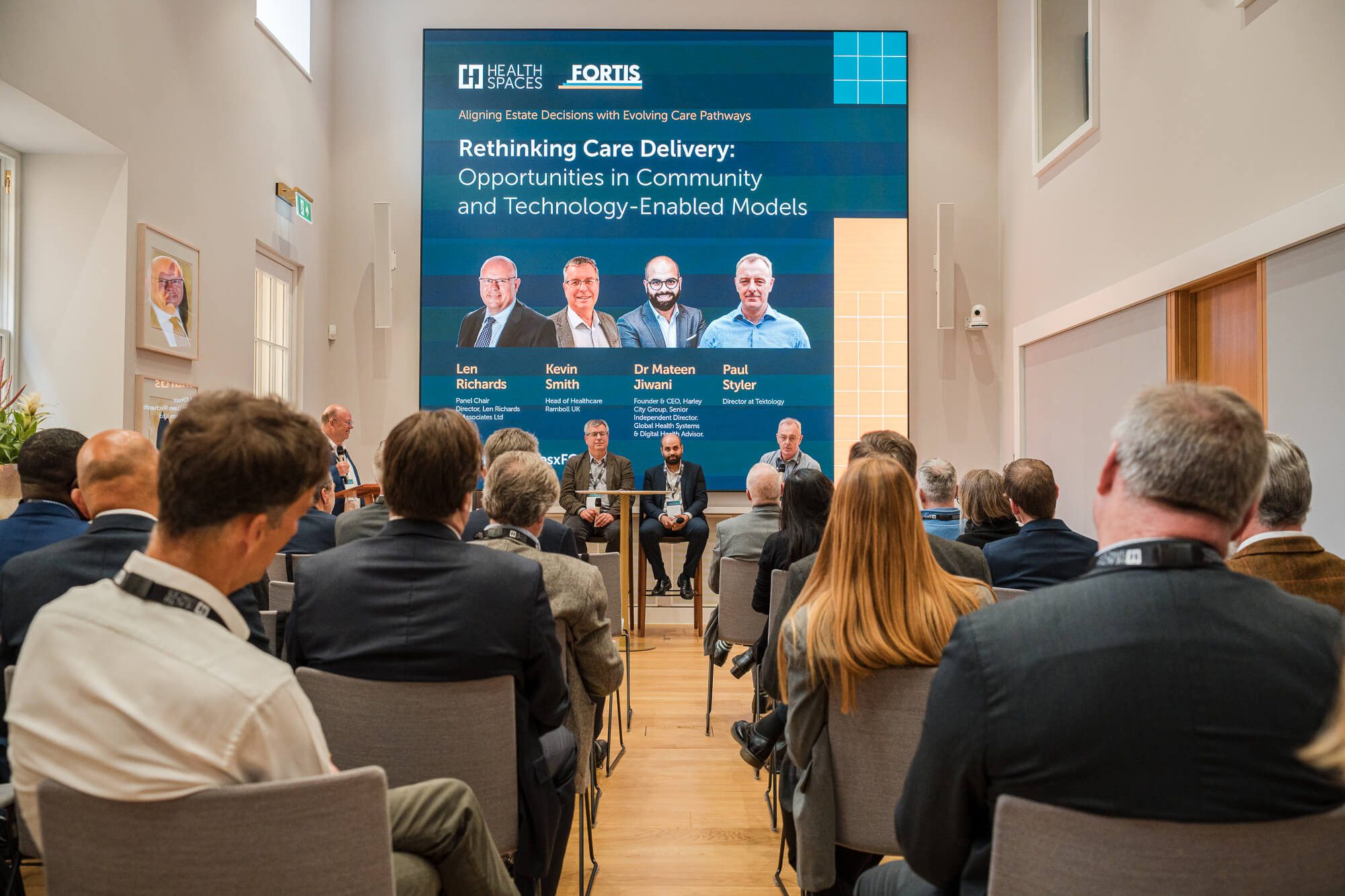
This article draws on insights shared during the second panel discussion at the Health Spaces x FORTIS roundtable, Aligning Estate Decisions with Evolving Care Pathways. Chaired by Len Richards, Former Trust CEO, the panel brought together perspectives from Kevin Smith, Head of Healthcare at Ramboll UK; Dr. Mateen Jiwani, Founder and CEO of Harley City Group; and Paul Styler, Director at Tektology.
Len opened the discussion by reflecting on international examples of integrated care, including the Canterbury District Health Board in New Zealand. From 2004 onwards, Canterbury pursued a model of care closer to home that brought together primary care, diagnostics, urgent response and voluntary sector support around the patient pathway. By 2016, it had been identified by The King’s Fund as one of the leading integrated health systems globally, with lower admissions, shorter lengths of stay and higher levels of patient satisfaction.
The point was not that the NHS can simply copy another system’s model. It was that alternatives do exist, and that meaningful change depends on aligning services, estate, workforce and culture around the way care actually needs to be delivered. For estate leaders, that means treating buildings as part of pathway redesign, rather than as standalone capital responses to operational pressure.
The discussion moved beyond the familiar language of left shift and digital transformation. Instead, it explored a more difficult question: what actually has to change if community-based and technology-enabled models are to reduce pressure on acute care, improve access for patients and create a healthcare estate fit for the future?
The answer that emerged was clear. New locations and new technologies will not transform care on their own. They only create value when they are connected to pathway redesign, workforce capability, patient behaviour, infrastructure readiness and long-term leadership decisions.
The risk of moving care without changing the model
The language of left shift is now familiar across health policy and system planning. It captures an important ambition: to reduce avoidable reliance on acute hospitals and support more people in community, neighbourhood and home-based settings. But the practical question is more difficult. When services move, does the model of care change with them?
Len’s Canterbury example set up this question clearly. Care closer to home worked there because it was not treated as a separate community initiative or an estate project in isolation. It was part of a wider integrated model, where urgent care, diagnostics, primary care and voluntary sector support were designed to work together around the patient.
This was one of the key issues explored by the panel. Community diagnostic centres, neighbourhood health centres, virtual consultations, remote monitoring and digital access routes all have the potential to improve care. But their impact depends on whether they are part of a redesigned pathway, or whether they simply replicate existing processes in a different setting.
Dr. Mateen reflected on this through his experience of early video consultations. The technology was available long before it became widely accepted, but the wider system was not always ready to support it. Governance, training, professional confidence and infrastructure all had to catch up with what was technically possible.
His observation that “technology is quite hard to embed” speaks to a wider truth. The challenge is rarely the technology alone. It is the work needed around it: understanding the patient journey, supporting staff to use it well, creating the right governance and ensuring the infrastructure is reliable enough for everyday use.
This distinction matters for estates and system leaders. A new community facility may support a shift away from hospital, but only if the service model changes with it. That means designing services, pathways and estate together from the outset, rather than adapting new buildings around existing patterns of referral, access and professional working.
If the same referral routes, professional dependencies and access barriers remain, then the opportunity may be limited. The building may be different, but the experience for patients and staff may not change as much as intended. The question for leaders is therefore not only where care should be delivered, but what needs to be different about the way that care is accessed, coordinated and supported.
A more patient-centred understanding of access
One of the strongest themes in the discussion was the need to look again at what access means from the patient’s perspective. Traditionally, access has often been measured through appointments, clinic capacity and points of contact with professionals. These remain important, but they do not fully capture the experience of people using services. For patients, access is often shaped by much more practical considerations:
- How far do they need to travel?
- Can they get an appointment at a time that works for them?
- Do they need to take time off work?
- Can they understand where to go?
- Can they receive advice, tests or results without making unnecessary journeys?
Dr. Mateen gave a personal example. After being invited for a blood test, he found that the available locations were inconvenient and the opening hours difficult to work around. The issue was not the clinical value of the test. It was the way the service was arranged around the system rather than around the patient. His conclusion was that healthcare can become so focused on clinical productivity that it risks overlooking “productivity for patients.”
That idea is important. Productivity in healthcare is usually discussed from the perspective of organisations: clinic utilisation, staff time, activity levels and throughput. But patient productivity matters too. A service that is efficient for the organisation may still be inefficient for the person using it if it requires avoidable travel, waiting, duplication or uncertainty.
Community and technology-enabled models create an opportunity to rebalance this. Remote testing, digital communication, better triage, home monitoring and more flexible local services could make care easier to access and more responsive to need. But this requires services to be designed around real behaviour, not idealised pathways.
The ambition should not be to remove human contact. It should be to make sure that contact happens when it adds value, and that patients are not required to navigate unnecessary steps simply because the system has always worked that way.
Technology as part of the care model
The panel was clear that technology should not be seen as a solution in isolation. New systems, platforms and devices can support better care, but only when they are linked to a clear purpose. Kevin Smith made this point through his reflections on automation. In some international healthcare projects, technologies such as automated guided vehicles, pneumatic tube systems and robotic processes are treated as part of the operational infrastructure of the hospital. Their value lies not in novelty, but in their ability to release staff from repetitive tasks, reduce errors and improve the use of space.
He noted that automation can, in some settings, help reduce floor area requirements and improve operational flow. But the broader lesson is that technology works best when it is connected to the realities of workforce, estate and patient care.
This is particularly relevant in the NHS, where investment decisions are often shaped by immediate capital affordability. Technologies that may deliver value over five, six or seven years can be difficult to justify if the financial framework is focused on shorter-term costs. The risk is that schemes choose what is affordable now, while missing opportunities to improve productivity and resilience over time.
Paul Styler described the need to think more carefully about the time horizons for technology. Buildings may be planned over decades, while technology is often treated as a shorter-cycle investment. Yet future models of care will depend heavily on digital infrastructure, data, interoperability and connected systems. If these are considered too late, they can become constraints rather than enablers.
This is especially important for neighbourhood and community models. A neighbourhood health centre may bring together several providers, each with different systems, processes and governance requirements. If technology is not designed into the operating model from the start, staff may find themselves working in a modern building while still navigating fragmented digital systems. That is not a failure of ambition. It is a reminder that technology has to be planned as part of the care model, not added after the building or service has already been designed.
From smart hospitals to smart healthcare
One of the most useful distinctions in the discussion was the difference between a smart hospital and smart healthcare. Kevin Smith challenged the tendency to define smart hospitals largely through building systems. A highly sophisticated building management system can monitor temperature, humidity, plant performance, door openings and energy use. These things are valuable, particularly for estates and facilities teams. But they do not necessarily improve the experience of patients or the productivity of clinical staff. The more important question is how technology supports care. Smart healthcare starts with the outcome:
- Does the technology help patients move through the system more easily?
- Does it give staff the information they need at the right time?
- Does it reduce unnecessary appointments or duplication?
- Does it help identify risk earlier?
- Does it support a better experience for people using and delivering care?
This wider view requires different voices to be involved earlier. Estates, digital, clinical, operational, finance and patient perspectives all need to shape the same conversation. If one voice dominates, the technology may solve one problem while creating others.
That is why governance matters. Paul Styler argued that technology, data and digital need to be elevated into senior leadership discussions more consistently. They cannot sit on the edge of capital planning or arrive late in the process. If technology is going to shape how care is delivered, it needs to be treated as a core strategic issue.
For senior leaders, the question is not simply what technology a scheme should include. It is what the technology is expected to enable, who it is for, and how the organisation will support people to use it well.
Leadership and the conditions for change
The discussion repeatedly returned to leadership. Community and technology-enabled models require practical decisions that can be difficult to make in a pressured system.
Leaders are being asked to balance operational performance, financial constraint, workforce pressures, capital limitations and rising public expectation. In that context, it is understandable that transformation can become incremental. The immediate demands of the system often leave limited space to step back and ask what needs to be fundamentally different. Yet that space is essential.
Dr. Mateen argued that leaders need to be better equipped to make decisions about technological innovation, particularly where those decisions involve risk, new partnerships or changes to professional roles. The issue is not only whether leaders support innovation in principle. It is whether they have the confidence, governance and organisational support to make it work in practice.
Paul Styler also pointed to the behavioural challenge. If new models are introduced while old routes remain unchanged, people may continue to use the systems they know. A business case may assume that activity will shift, but staff and patients may not automatically change their behaviour. In some cases, leaders may need to make clear decisions about what will stop, what will move and what will be repurposed.
That does not mean change should be forced without engagement. It means that transformation requires clarity. New models need to be supported by communication, training, infrastructure and trust. But they also need decisive leadership.
For integrated care systems, this is likely to become increasingly important. The promise of community and technology-enabled care depends on the ability to connect strategy, resource allocation and delivery across multiple organisations. That requires careful project selection. Not every idea can be pursued at once. The systems that make the greatest progress may be those that focus on a smaller number of high-value changes and align estates, technology, workforce and pathways behind them.
A more practical definition of transformation
The panel discussion made clear that community and technology-enabled models offer a significant opportunity, but they are not simple solutions. Their success depends on the quality of the planning that sits behind them: the pathway being redesigned, the workforce model required to deliver it, the infrastructure needed to support it and the outcomes the system is trying to achieve.
For senior leaders, this requires a shift in emphasis. Decisions about community and technology-enabled care need to move beyond whether activity can be relocated or whether a new tool can be introduced. The more important test is whether the model will improve how care is accessed, coordinated and delivered. That means understanding what needs to change around the service, how patients and staff will experience it, and whether the investment will create better routes into care before hospital becomes the default.
Seen in this way, community and technology-enabled models can support more accessible, preventative and efficient care. They can help make better use of clinical time, reduce unnecessary journeys for patients and create a more flexible estate. But their success will depend on whether estate, technology and workforce decisions are made as part of the same pathway conversation.
The future healthcare estate will not be defined simply by hospitals, neighbourhood centres or digital platforms. It will be defined by how well those elements work together around changing models of care. If the NHS can align estate decisions with evolving care pathways, the shift from hospital to community can become more than a policy ambition. It can become a practical, sustainable and more human model of care.