Article Summary
Art in healthcare is often treated as a finishing touch, but its impact can be far more significant. Based on insights from healthcare arts and design specialists, this article explores how considered artwork can support patient wellbeing, improve staff environments and help create more human, calming and meaningful healthcare spaces.
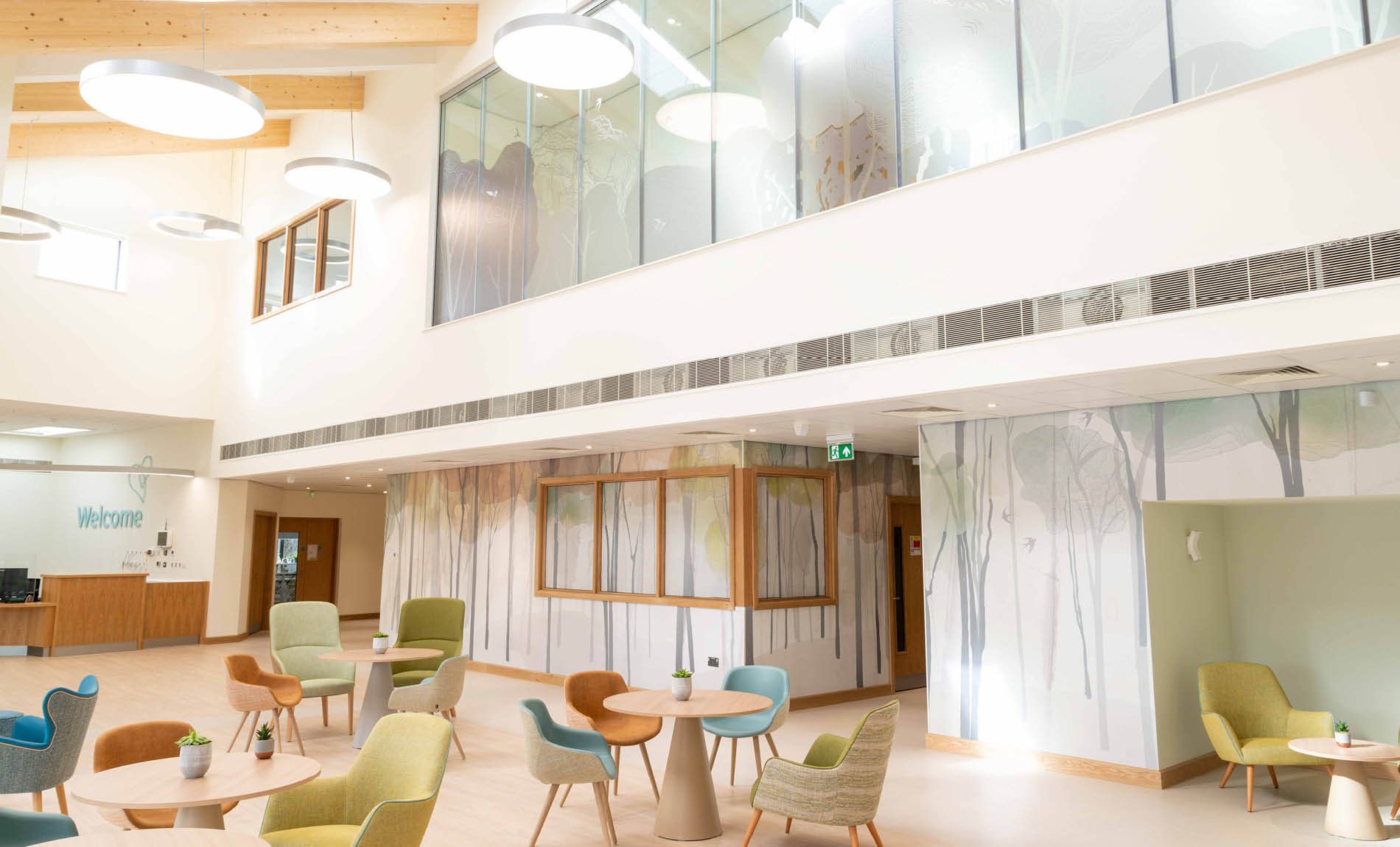
Art in healthcare is too often treated as something added at the end of a project. It is seen as a way to soften a waiting room, brighten a corridor or make a clinical space feel less severe once the more technical decisions have already been made. But when art is considered properly, it can do far more than improve how a space looks. It can influence how patients feel, how staff experience their workplace and how people move through, understand and connect with healthcare environments. In settings where anxiety, pain, uncertainty and pressure are part of daily life, the design of the environment matters.
This was a central theme explored in a Health Spaces webinar with Kate Bond, Surface Designer, Elaine Lewis, Interior Designer; Lisa Harty, Art & Design Manager at Somerset NHS Foundation Trust; and Hetty Dupays, Art & Design Manager at Royal United Hospitals Bath NHS Foundation Trust. The discussion moved beyond the simple question of whether art has value in healthcare. Instead, it focused on what it takes to embed art meaningfully, safely and practically within real NHS settings.
Art should be considered from the beginning
One of the clearest messages from the discussion was that art has the greatest impact when it is considered from the beginning of a project. Too often, artwork is introduced after key design decisions have already been made. By that stage, it can be harder to connect the artwork to the purpose of the space, the needs of patients and staff, the wider interiors strategy and the practical demands of a clinical environment.
Lisa explained that every scheme should begin by asking whether there is an opportunity for artist involvement and what that involvement could achieve. Not every project will require a major arts programme, but if the question is not asked early, opportunities can easily be missed. Hetty made a similar point, noting that art works best when it is integrated into the design and build from the outset. In reality, arts teams are not always involved at that stage. Sometimes they enter a project halfway through or towards the end, which requires flexibility and quick decision-making. But the principle remains the same: the earlier art is considered, the more likely it is to feel connected to the building rather than placed on top of it.
This is particularly important in healthcare, where art may need to do several things at once. It can support wayfinding, reduce the clinical feel of a space, create a sense of calm, reflect local identity or provide a point of connection for patients, visitors and staff. These outcomes are much easier to achieve when art is part of the original design conversation.
Engagement is essential, but it needs structure
The webinar also highlighted the importance of engagement. Healthcare spaces are used by many different groups, often with very different needs and expectations. Patients, families, clinical teams, estates teams, infection prevention specialists, charities and local communities can all have a role in shaping how a space should feel and function.
However, engagement needs to be thoughtful. It cannot simply be a broad invitation for opinion. Different projects require different approaches, from workshops and group sessions to individual meetings and more interactive formats. The method needs to reflect the nature of the space, the people using it and the outcome the project is trying to achieve.
At Royal United Hospitals Bath NHS Foundation Trust, Hetty described how key stakeholders are identified at the start of a project and included in consultation. Clinical staff have been involved in workshops to review proposals for their departments, while patient representatives have contributed through workstreams and engagement sessions. This approach helps ensure that artwork is not chosen in isolation from the people who will experience it every day.
However, engagement also needs leadership. Patients and staff can help shape the direction of a project, but the arts manager, designer or curator has an important role in translating that input into a coherent design response. Without that expertise, engagement can become a collection of preferences rather than a considered outcome.
The role of art in patient and staff experience
One reason art can be difficult to secure in healthcare settings is that it is sometimes perceived as a “nice to have”. In a system under pressure, with limited budgets and competing operational demands, anything seen as non-essential can quickly be pushed aside.
The panel challenged that assumption; the benefits of art are not only aesthetic. For patients, artwork can provide distraction, reduce anxiety, relieve boredom and create a greater sense of independence and control. Lisa also pointed to wider evidence around the positive impact art can have on pain and medication levels and recovery, including examples where music workshops have supported patients recovering from strokes.
For staff, artwork can also change the experience of the workplace. It can make clinical environments feel more human, provide moments of relief during stressful days and create points of conversation between staff, patients and families. In services where pressure is constant, the quality of the working environment should not be underestimated. Hetty described the arts as supporting “physical, mental, and emotional recovery, relieving anxiety, and decreasing the perception of pain.” She also highlighted the value of participatory and performance arts, which can create a more sociable and stimulating environment for patients.
This matters because healthcare environments communicate something to the people inside them. A space that feels sterile, confusing or uncared for can add to distress. A space that feels calm, thoughtful and connected to the outside world can support a different experience of care.
Balancing creativity with clinical requirements
For art to succeed in healthcare, it has to be practical. The panel was clear that artwork, materials, fabrics and finishes all need to be considered alongside infection prevention and control, fire safety, durability, maintenance and clinical function.
This does not mean creativity has to be limited. In fact, the panel noted that the industry has developed more innovative materials and formats in response to the requirements of healthcare environments. Suitable upholstery fabrics, wall coverings, acoustic panels, wall panelling, light boxes and new ways of displaying artwork can all help create more considered spaces while meeting clinical standards.
Kate also raised an important point about sustainability. Healthcare settings often require strict material standards, but some of the available options are not always environmentally friendly. As she explained, “I fully understand why hospitals are so strict with regards to infection control, but most options are not so environmentally friendly.” This creates a real challenge for designers and artists trying to balance infection control, durability and environmental responsibility.
The answer lies in collaboration. Arts teams and designers need to work with infection prevention, estates, fire safety and clinical colleagues from the start. When these conversations happen early, it becomes easier to find solutions that are safe, compliant and still visually meaningful.
Building arts capacity across NHS Trusts
A major challenge for many NHS organisations is that not every Trust has a dedicated arts team. The panel recognised that this could make it harder to embed art consistently, particularly when there is no one with clear responsibility for commissioning, curating, maintaining and advocating for artwork. Lisa argued that
Every NHS Trust should aspire to have an arts team if the arts are to be truly embedded into healthcare environment.
Without that internal expertise, art can become fragmented or dependent on individual enthusiasm.
However, Trusts without dedicated arts teams still have options. External arts consultancies, local arts groups, charities and organisations such as Paintings in Hospitals can all support healthcare providers to introduce artwork. Specialist networks and training can also help organisations understand how to commission artists and manage projects appropriately.
What matters is that art is approached with care. Bringing artwork into a hospital is not simply about finding images for empty walls. It requires thought about placement, scale, suitability, maintenance and the overall experience of the space. Even a simple display of 2D artwork needs to be considered carefully if it is to feel intentional rather than random.
Aligning funding with the purpose of the space
Funding for art in healthcare varies significantly between organisations. Some projects are supported through a percentage of capital funding, while others rely on hospital charities, grants, ward-level budgets or income generated through exhibitions.
The important point raised in the discussion was that funding should follow the purpose of the project. Lisa explained that it is always better to understand the project first then look at funding opportunities, rather than fit a project to a potential funding stream. Otherwise, there is a risk of shaping the project around the funding source rather than the needs of the space and the people using it.
At Royal United Hospitals Bath, Hetty described a model where core roles are funded through the NHS as part of estates and capital projects, while larger capital projects include a small budget for arts commissioning. Participatory and live music projects are often supported through fundraising and grant applications.
This shows why art in healthcare needs strategic commitment. If art is left to chance, it becomes vulnerable to the availability of small pots of money and individual advocacy. If it is built into capital planning, estates strategies and patient experience thinking, it becomes part of how an organisation thinks about the quality of its environment.
Choosing artwork with purpose and sensitivity
Another important theme raised during the discussion was the need to design for specific patient groups, spaces and services. There is no single approach that works everywhere. Different patient groups, services and spaces require different approaches. A children’s department, an oncology centre, a mental health unit and a staff rest area will not need the same response.
The starting point should be the people using the space, the function of the area and the emotional experience associated with it. Stakeholder engagement can help identify themes, but professional judgement is also needed to avoid choices that may be inappropriate or overly personal.
Hetty advised avoiding portraiture in many healthcare settings and bringing in elements of the natural world. Kate highlighted the value of biophilic design, described it as “universal for all genders and ages,” while also recognising that the specific approach still depends on the location and end user.
Themes may come from local history, surrounding landscapes, patient and staff input, colour palettes or the purpose of the service. The strongest schemes are rarely about choosing artwork in isolation. They are about creating a visual language that supports the wider environment.
Recognising art as part of the care environment
The strongest argument from the conversation was that art should not be treated as separate from the healthcare environment. It is part of how that environment works.
Art can help people find their way. It can make a space feel less intimidating. It can support recovery, conversation and emotional wellbeing. It can help staff feel that their workplace has been designed with care. It can connect hospitals to local communities and make clinical spaces feel more human. But this does not happen automatically. It requires early involvement, structured engagement, senior support, practical collaboration and a clear understanding of what the artwork is there to achieve.
For Trusts looking to make better use of art, the advice from the panel was clear: start early, involve the right people and value the role of the arts in shaping healthcare experience. As Hetty put it, Trusts need to
Be open minded and ambitious and, above all else, value the role of the arts in a healthcare environment
In a health system where buildings are often judged by their capacity, compliance and efficiency, it is easy to overlook the quieter role of environment in shaping care. Yet patients and staff do not experience healthcare as a set of technical requirements. They experience it through spaces, sounds, colours, materials, moments of anxiety and moments of reassurance.
Art cannot solve the pressures facing the NHS, but it can change how healthcare spaces feel, function and connect with the people who use them. That makes it far more than decoration. It makes it part of the care environment itself.