
Article Summary
In conversation with Dr. Scott Zeller, MD and Pioneer of EmPATH model, this article looks at what happens when emergency mental health care is redesigned. The EmPATH model is already changing outcomes internationally, but what could it mean for the NHS? At a time of rising demand and constraint, it offers a new way of thinking about crisis care.
Mental health demand is rising at a pace the NHS is structurally unprepared for. Emergency departments are seeing unprecedented numbers of people in acute psychiatric distress, many waiting for hours, sometimes days, for assessment or treatment. Clinicians recognise a system that is failing these patients and operational leaders see overcrowding undermining flow. Across the service, there is a growing acceptance that the current approach is not only unsustainable but fundamentally mismatched to the needs it is intended to meet. This is not simply a question of capacity. It is a question of model.
Few challenges in the NHS are as visible, or as persistently unresolved, as the intersection between emergency care and mental health. A&E departments remain the default entry point for people in crisis, despite being environments that can heighten distress and escalate behaviours that might otherwise settle with the right kind of support. The result is a system overstretched, clinically inefficient and increasingly out of step with, to the realities of modern mental health emergencies.
This article draws on insights and experiences shared in a FORTIS conversation with Dr. Scott Zeller, one of the leading voices in emergency psychiatry and the pioneer of EmPATH (Emergency Psychiatric Assessment, Treatment and Healing) model. His work challenges long-standing assumptions about how crisis care should be delivered. And as Dr. Zeller highlights, it is grounded in a simple but often overlooked premise:
Psychiatric emergencies should be treated with the same immediacy, intent and clinical focus as any other acute condition
Now operating across more than sixty sites internationally, with over 100 expected by the end of 2027, the EmPATH model is demonstrating measurable improvements in outcomes, safety and cost. It offers compelling evidence that environment and process are not secondary considerations, but core clinical interventions in their own right. At a time when the NHS is grappling with rising demand, workforce pressures and financial constraint, it points towards a fundamentally different way of structuring emergency mental health care.
A different starting point for crisis care
EmPATH units began with a question that seems obvious in hindsight: what would happen if people in crisis were removed from the noise, pressure and clinical overstimulation of a conventional A&E, and instead treated immediately by mental health clinicians in an environment designed for comfort, autonomy and de-escalation?
For Dr. Zeller the answer emerged through years of frontline experience. Him and his team recognised early on the importance of space, autonomy and emotional safety in preventing escalation. As he put it,
We found that a lot of de-escalation had to do with giving people space and making them comfortable, having them able to meet their needs independently
This insight shaped the first EmPATH unit in California. Rather than replicating the restrictive conditions often associated with emergency psychiatric care, the unit was designed as a calm, open space where patients could move freely, access food and drink, and engage with clinicians without the barriers that typically exist in emergency settings. Treatment begins quickly, medication is offered where appropriate, and the environment itself works to reduce distress rather than amplify it.
What followed challenged long-standing assumptions about crisis care. A significant majority of patients (75%), including those brought in involuntarily by police, were stabilised and able to return home within 24 hours. Outcomes that might previously have led to admission were resolved in a matter of hours. This outcome has since been replicated across dozens of sites. Perhaps even more striking is the reduction in coercive interventions. In standard emergency settings, Dr. Zeller notes that “Around 15 to 20% of highly acute patients end up in physical restraints and forcibly medicated.” In EmPATH units, the figure is one or two per thousand. When the environment and clinical response are aligned, behaviours that are often treated as risks to be controlled can instead be understood as conditions that can be stabilised.
Why the NHS needs a new model
The NHS currently sits between two competing philosophies. One argues for separate, standalone mental health emergency centres located away from acute hospitals. The other keeps patients in the main A&E environment and isolates them in small, ligature-safe rooms that offer safety but little therapeutic value.
Both approaches have drawbacks and both fail to recognise what Dr. Zeller describes as treating “the whole patient.” Acute psychiatric presentations are rarely isolated. Many patients arrive with medical comorbidities, intoxication, withdrawal syndromes, physical injuries or underlying conditions that require immediate clinical oversight. Others are simply too distressed or unpredictable to be safely managed in community-based settings.
As Dr. Zeller emphasised, “You can’t just say you have all this stuff elsewhere.” There are groups of patients who will always require access to emergency departments, regardless of how well alternative services are developed. This tension is already being felt across the system. Emergency mental health demand continues to rise, A&E wait times are worsening, and inpatient psychiatric capacity remains both limited and costly.
Mental health Trusts acknowledge that their emergency provision is under strain, while acute Trusts are increasingly required to manage complex behavioural presentations in environments not designed for that purpose. The result is a system caught in the middle. One that is trying to separate mental health from acute care, while simultaneously relying on emergency departments to absorb growing demand. The challenge is no longer purely clinical. It is operational, financial and infrastructural.
What makes an EmPATH unit different
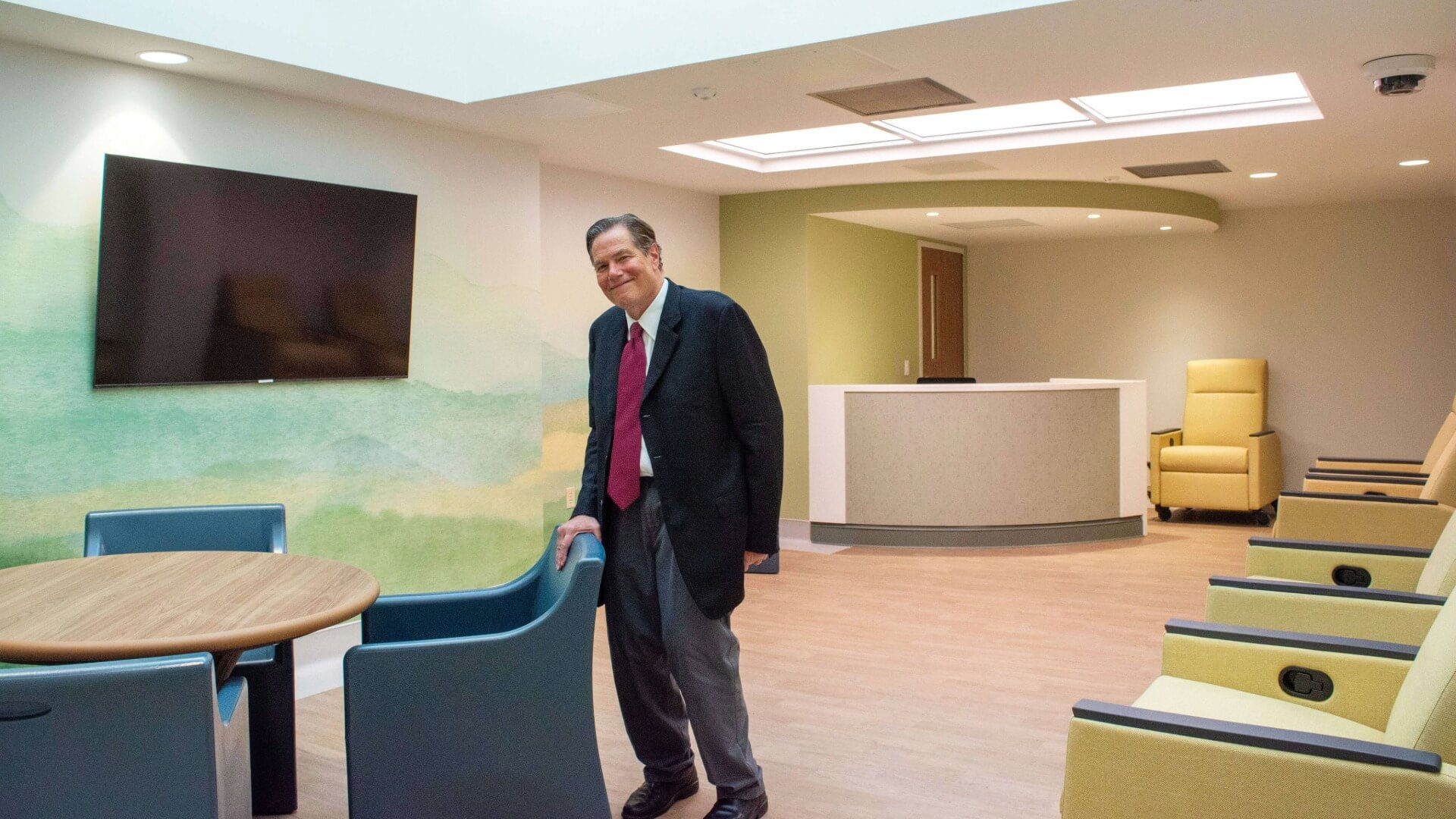
An EmPATH unit sits adjacent to, or directly connected with, the emergency department, but the experience is fundamentally different from the moment a patient arrives. Patients are brought straight into a large open-plan care lounge where they can move freely, access food and drink, retrieve their own bedding and engage with staff. This change in environment changes how people respond.
Treatment begins immediately, often within minutes of arrival. The atmosphere is calm, allowing for pacing, conversation, rest, distraction and peer reassurance. People who are acutely distressed tend to regulate more quickly when they are not confined, observed harshly or treated as a threat. Many agree to medication voluntarily once they feel emotionally safe. What becomes clear is that the environment is not a backdrop of care but part of the treatment itself.
A financial argument the NHS cannot ignore
In the NHS, financial constraint is often framed as a barrier to innovation. Yet one of the more compelling aspects of the EmPATH model is that its value is not limited to clinical outcomes; it also shapes the economics of emergency care. Dr. Zeller points to examples where the model has delivered measurable system-wide savings, “We have a study showing that in their first two and a half years of operation, including the cost of running the unit, they saved Medicaid $34 million,” he explained referring to a California site operating entirely from modular construction placed directly alongside the emergency department. Another hospital reported savings of over $860,000 in its first year, driven largely by improved patient flow and reduced pressure on emergency department capacity.
The relevance to the NHS is clear. Much of the current cost burden sits in places that are often treated as operational challenges rather than financial ones. Long A&E waits, psychiatric boarding, delayed discharges and unnecessary inpatient admissions all carry significant, and often hidden, costs.
What the EmPATH model demonstrates is that these pressures are not fixed. When patients are assessed and treated quickly in an environment designed for stabilisation, fewer require admission. Emergency department beds are freed up more rapidly. Staff time is used more effectively, and reliance on security, restraint and escalation reduces. In that context, the EmPATH model is not an expense but an investment with demonstrable return.
Why the opportunity is now
The conditions for change are already in place. Demand continues to rise, emergency departments are under sustained pressure, and there is growing recognition that current models are not delivering the outcomes patients or systems need. At the same time, there is increasing openness to rethinking how care is structured. Across both acute and mental health services, the conversation is beginning to move beyond capacity alone, towards how environments, pathways and clinical response shape outcomes. In that context, the relevance of the EmPATH model becomes clearer.
One of its defining strengths is that it does not depend on large-scale transformation to begin delivering impact. As Dr. Zeller noted, some of the most effective units in the US began as modular facilities, introduced quickly and operating alongside existing emergency departments with minimal disruption.
For the NHS, this shifts the challenge. It is no longer purely about whether a new model can be justified, but whether existing estate and service design can be adapted to support a different approach to crisis care. What is needed is not a single solution, but alignment between clinical ambition, operational reality and the environments in which care is delivered, an idea likewise examined by Fiona Lennon and Cheryl Riotto of the New Hospital Programme in their FORTIS article.
A new blueprint for emergency mental health care
Emergency care in the NHS is evolving, and mental health provision must evolve with it. The EmPATH model does not replace existing services, instead, it addresses a gap that has long existed within the system: the point at which patients present in acute distress, but do not necessarily require admission if the right care is delivered at the right time. What it offers is a different way of thinking about that moment. One that is grounded in immediate treatment, supported by environment, and designed around stabilisation rather than containment.
For a system under sustained pressure, this is not simply a new service model. It is a blueprint for how emergency mental health care can be delivered more effectively, more efficiently and more humanely. The opportunity for the NHS is not just to adopt this approach, but to adapt it. To shape it around the realities of the UK system, and in doing so, redefine what the front door of mental health care looks like.