Article Summary
Drawing on insights from the first Health Spaces x FORTIS roundtable, ‘Beyond Building More: Rethinking Build More Space as the Default Response’, this article explores why NHS estate strategy so often defaults to expansion, and what needs to change. With contributions from Len Richards, David Highton, Paul Fenton and Zoë Watters, the discussion considers how future capital investment can start with a more fundamental question: what model of care are we trying to enable?
The NHS estate is under pressure from almost every direction. Ageing buildings, growing demand, constrained capital, workforce shortages and rising expectations are all shaping decisions about where and how care should be delivered. For many organisations, the need for investment is undeniable. Too much of the estate is outdated, inefficient or no longer fit for the models of care the NHS is now being asked to provide. But the harder question is not whether the NHS needs investment. It is what kind of investment will genuinely change care.
Too often, the answer to estate pressure has been to build more. More beds, more clinical rooms, more theatre capacity, more diagnostic space, more acute provision. In some cases, this is necessary. The NHS cannot transform care from buildings that are unsafe, inflexible or functionally obsolete. Yet the discussion cannot stop at condition, capacity or replacement. If capital investment simply recreates existing models at a larger scale, it risks reinforcing the very pressures it is meant to resolve.
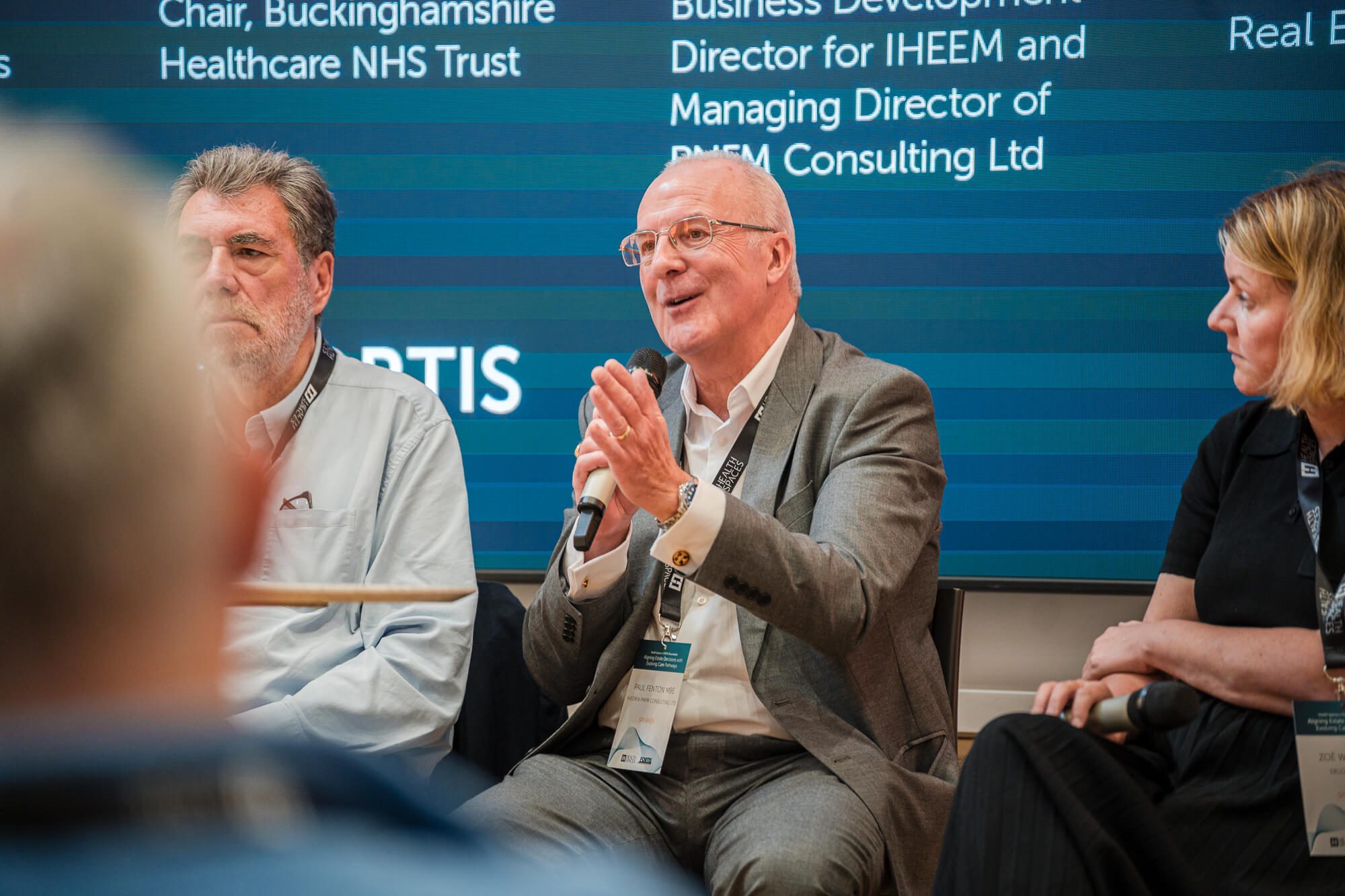
This article draws on insights from the first panel of the Health Spaces x FORTIS roundtable, ‘Beyond Building More: Rethinking Build More Space as the Default Response’. Chaired by Len Richards Former NHS Trust CEO, the panel brought together David Highton, Chair of Buckinghamshire Healthcare NHS Trust; Paul Fenton, Former NHS Estates and Facilities Director and Business Development Director for IHEEM; and Zoë Watters, Partner at Deloitte. Together, they explored why NHS estate decisions so often default to expansion, and what needs to change if capital investment is to support future care models rather than reinforce the pressures of the present.
Why building more becomes the easier answer
Major capital schemes often begin with a genuine problem. Buildings may be deteriorating, clinical teams may be working in constrained environments, patient flow may be compromised, and operational risk may be increasing. In that context, replacement can feel like the most obvious and responsible answer. Yet replacement carries a risk. Len reflected on this through his experience of major infrastructure projects in England, Wales and Australia, including the Manchester Children’s Hospital, the Royal Adelaide Hospital and the replacement of Rookwood Hospital in Cardiff. Across those schemes, he observed that the investment was driven primarily by the poor condition of existing facilities, and as he put it,
The new development became a replacement for what was already there, only bigger
At Manchester Children’s Hospital, additional capacity was included because clinicians were not confident the new model would be enough. Within a year of opening, that spare capacity was in use. At the Royal Adelaide Hospital, the new facility was intended to consolidate services, but the existing hospital it was meant to replace continued to operate. Services expanded to fit the estate. These examples matter because they show how quickly new buildings can be absorbed by old patterns. This is because building something is often more tangible than changing the conditions that create demand in the first place. Clinical teams understandably ask for the space they believe they need; boards need to address risk, systems need deliverable plans and national programmes need defined outputs. When services are already stretched, asking for more space can feel safer than asking whether the model itself needs to change.
Zoë put it clearly during the panel. When asked why hospital investment can feel like the safest option, she challenged the premise: “I don’t think it’s the safest. I think it’s easier.” Demand management, discharge and connections with social care have been discussed for years, she argued, but have not moved forward enough. The “really difficult stuff” needed to reduce demand on acute care is where the system has repeatedly struggled to make progress. That distinction is important. Building more may feel decisive, but it can also be the more comfortable response. It avoids some of the harder questions about how care is organised, how patients move through the system, where clinical work takes place, how social care is connected, and what activity should no longer default to an acute site.
That matters because the NHS is not simply trying to accommodate more demand, but to change the pattern of demand. The left shift is not about moving activity for its own sake; it is about changing where care happens, how patients access services, which professionals are involved, what technology enables, and what role hospitals should play in a more integrated system. If the NHS begins with the building, it is likely to reproduce the model it already knows. If it begins with the pathway, it has a better chance of asking what should stay, what should move, what should change and what should stop.
The risk of capital following programmes rather than pathways
Estate strategy is often described as an enabler of clinical strategy, and rightly so. Buildings should support care, not dictate it, but in practice the relationship is rarely that simple. Clinical strategies are not always clear, current or detailed enough to guide long-term estate decisions. Service models change, demand shifts, workforce assumptions evolve and digital and technological possibilities move quickly. As Paul observed during the discussion, if estates leaders always waited for a fully formed clinical strategy before developing an estate strategy, they might never write one at all. His argument was not that estate should lead instead of clinical strategy, but that estate, clinical, operational and financial planning need to happen together.
That also means designing for change, not just for the service model as it exists today. As Paul argued, the estate needs to be flexible enough to adapt as clinical models, technology, workforce assumptions and population needs continue to evolve. Otherwise, capital investment can solve an immediate problem while locking the system into another version of the present.
Too often, capital schemes begin with the condition of the estate, the need for more capacity, or the availability of a funding programme, before there has been enough time to test what the service itself needs to become. A programme becomes available, a site is identified, a business case is developed, and only then does the system try to show how the investment supports transformation. By that stage, some of the most important questions may already have been pushed too far down the line:
- What pathway is this investment trying to change?
- Which patients should no longer need to attend an acute site?
- What activity could be delivered differently?
- What existing space will be released, closed or repurposed?
- How will this investment reduce pressure rather than simply absorb more demand?
Unless those questions are asked early, the scheme may still deliver a better building but miss the bigger opportunity to change care.
Zoë pointed to one of the recurring frustrations in NHS capital planning: when national programmes emerge, systems understandably respond to them. NHP, neighbourhood health centres, community diagnostic centres and other initiatives all bring important opportunities, but they can also encourage organisations to focus on the capital that is available rather than the model of care their population needs. Her point was simple:
The NHS should be building the right things, not just building because a programme exists
That does not mean slowing investment down. It means making the case for investment more closely tied to the change it is meant to deliver. Before a system decides what to build, it needs to be clear about what it is trying to shift. Is the priority to reduce avoidable admissions, move diagnostics closer to primary care, support same day emergency care, create more resilient elective capacity, reduce outpatient footfall on acute sites, or improve access for specific communities?
Each of these ambitions leads to a different estate answer. Without that clarity, the NHS risks building a generic solution to a problem that is much more specific.
Reframing capital investment around the wider system
A recurring theme across the discussion was that estate decisions need to move beyond the priorities of individual organisations and be tested against the needs of the wider system. Len captured this clearly when he argued that the NHS needs to “think system not Trust, to think service delivery not building project, and above all, to be patient centric, not clinician centric.” That shift is difficult because estate is usually owned, managed and risk-assessed by individual organisations. A Trust knows the condition of its buildings, it knows where the operational pressure is, and it knows which services are struggling for space. So, when it is asked what investment it needs, it will naturally answer from that perspective.
But many of the changes the NHS now needs cannot be solved by one organisation alone. Avoidable admissions, delayed discharge, outpatient demand, access to diagnostics, community capacity and prevention all sit across organisational boundaries. They involve acute providers, primary care, community services, mental health, social care, local authorities, voluntary sector partners and patients themselves.
This is particularly important when large acute investments are being planned. If a hospital is being rebuilt, refurbished or expanded, the question cannot only be what the hospital needs on its current site. It also has to be what the wider system needs from that hospital over the next 10, 20 or 30 years. Some activity will always need to remain in acute settings. Specialist services, emergency care, complex diagnostics, critical care and high-acuity pathways require infrastructure that cannot simply be dispersed. But much of what currently happens on hospital sites is there because the pathway has grown around the institution, not because the patient always needs to be there. This is especially important in the context of the shift from hospital to community. If the NHS is serious about moving more care closer to home, estate strategies need to show how that shift will happen in practice. Otherwise, there is a risk that large capital schemes continue to reinforce acute-centred models, even while policy points in another direction.
Making Neighbourhood Care Work in Practice
David’s reflections from Buckinghamshire provided a practical example of how estate decisions can begin to support a different model. Buckinghamshire Healthcare NHS Trust is both an acute and community provider, which gives it a stronger platform for thinking across pathways. In Wycombe, the Trust is progressing a significant build intended to help empty much of an ageing tower, while also purchasing council offices that could accommodate GP practices, council services, voluntary sector space and activity currently delivered from the acute hospital. The important point is not just that activity may move out of hospital. It is that the estate is being considered as part of a wider model of care.
Neighbourhood care cannot be reduced to a single estate model. What works in a dense urban area may look very different from what is needed in a rural community of smaller town. Some places may benefit from a substantial neighbourhood hub that brings services together in one accessible location. Others may need a more distributed model, using existing public or commercial estate to keep care close to where people live. The key is not to centralise by default, but to understand where integration improves access and where it risks making services harder to reach.
This is where the opportunity of one public estate becomes much more significant. Local authorities often hold assets that are underused or could be repurposed, while town centres and commercial areas may offer vacant or adaptable space. Libraries, council offices and retail units can sometimes provide a more accessible front door for care than a traditional hospital campus. But making use of those opportunities requires different conversations from the ones the NHS is used to having. It asks leaders to think beyond organisational boundaries and to see estate as part of wider civic infrastructure, not just healthcare infrastructure. The potential benefit is considerable. A community diagnostic centre or outpatient service in a town centre can do more than reduce pressure on a hospital site. It can improve access, bring healthcare closer to people’s everyday lives, connect patients with other local services and support footfall in places that may be struggling. But the purpose has to be clear. If the same service is simply used to absorb hospital demand from a different building, the pathway may not have changed at all. The NHS may have moved the activity, but missed the opportunity to transform the model.
Designing around real patient journeys
Estate decisions are often shaped by the voices closest to the project: clinicians, finance teams, operational managers, estates professionals and national approval bodies. All of those voices matter, but the roundtable returned repeatedly to a more fundamental question: is the estate being designed around the way the system is used to working, or around the way patients actually need to access care?
That question changes the nature of patient involvement. It is not enough to ask people where a service should be located once a proposal has already taken shape. The more useful questions come earlier. How do people want to access care? What makes attendance difficult? Which appointments feel unnecessary? What support would help someone stay well, recover at home or avoid a hospital visit altogether? When does a patient need to be seen in person, and when would another route work better?
The answers will not be the same for everyone. For some people, travelling to an acute hospital for a short outpatient appointment may be costly, inconvenient and unnecessary. For others, the hospital may feel reassuring because it brings specialist advice and diagnostics together. Some patients will welcome digital access, while others will need face-to-face support. Some will benefit from diagnostics in a high street setting, while others will need integrated care from several professionals in one place. People with mobility needs, caring responsibilities, language barriers or complex conditions may experience access in ways that standard planning assumptions can easily miss. This matters because the estate often reflects the habits of the system. Outpatient departments remain on acute sites because they always have been. Clinicians work from particular locations because job plans and service structures have grown around them. Patients travel to hospital because that is where the service is organised, not always because that is where the care needs to happen.
A more patient-centred estate strategy would start from the experience of access and then work back to the estate required to support it. That does not mean ignoring clinical judgement. The roundtable made an important distinction between a clinician-centred system and a clinically informed one. Estate should not simply be designed around established professional preferences, but nor can it be designed without deep clinical insight. The better conversation brings patients, clinicians and multidisciplinary teams together around the same question: what would make this pathway work better?
That requires honesty as well as engagement. Some services may need to move, some spaces may need to close or change, and some long-standing ways of working may need to be challenged. Without that, the NHS may continue to build around the model it says it wants to move beyond.
A better test for capital investment
The lesson from the roundtable is not that the NHS should stop building. In many cases, that would be unrealistic and unsafe. The condition of parts of the estate is too poor, and the demands on services are too great, for capital investment to be optional. The lesson is that building more should not be the default response to pressure. A new hospital, neighbourhood health centre, diagnostic facility or community hub should not be judged only by whether it increases capacity. It should be judged by whether it changes the right things. Does it support a different pathway? Does it reduce avoidable demand? Does it make care easier to access? Does it help staff work differently? Does it release capacity elsewhere? Does it connect with social care, voluntary sector and local authority partners? Does it make the system more adaptable, or does it lock in today’s assumptions for another generation?
These are not just technical questions to be resolved after the business case has begun. They are the questions that should shape the case for investment in the first place.
For senior leaders, the challenge is to move the estate conversation earlier. Before asking what needs to be built, boards and systems should be asking what model of care they are trying to enable, what activity genuinely needs to remain on the acute site, what could be delivered elsewhere, what existing space should be changed or released, and how the investment will reduce pressure rather than simply create more room for demand to grow into. The NHS has no shortage of estate problems. But the bigger risk is not only that buildings are old or inadequate. It is that new investment recreates old assumptions. If the next generation of NHS estate is to support the future of care, the starting point must be the pathway, not the building. The question is not simply how much space the NHS needs. It is what kind of care the estate is there to make possible.