Article Summary
Drawing on the international experience of Paul Fenton MBE CEng FIET FIHEEM FIWFM, a former NHS Executive Director of Estates and Facilities, Past Chairman of Hefma and Past President of IHEEM, this article examines how the Covid-19 pandemic, accelerating digital capability and the growing shift towards community-based care are reshaping healthcare infrastructure. Looking at approaches emerging across Europe and internationally, Fenton considers what the NHS can learn as it plans the next generation of hospitals and healthcare environments.

Hospitals are inevitably designed around assumptions: how many patients they will treat, the type of care they will provide and how their clinical spaces and supporting infrastructure will be used. Covid-19 demonstrated how quickly those assumptions can change.
Across the NHS, clinical teams had to repurpose wards, create additional treatment areas and separate patients and staff flows within buildings that had never been designed for those conditions. The experience exposed a fundamental challenge for healthcare estates: if a hospital works effectively only under the circumstances it was designed for, how resilient is it when demand, clinical practice or population need changes?
For Paul Fenton, Strategic Estates and Facilities, Engineering and Construction Consultant, the disruption of the pandemic reinforced the importance of designing healthcare infrastructure with change in mind.
That lesson was not unique to the UK. Previous experience of SARS, MERS and other infectious disease outbreaks had already encouraged several Asian health systems to place greater emphasis on infection control, surge capacity and adaptable clinical environments. Hospitals across Europe and elsewhere began looking more closely at these approaches, particularly as the limitations of more fixed models of hospital design became apparent.
Yet the pandemic was but one challenge. Ageing populations, rising levels of chronic disease, increasing demand for urgent and emergency care and the growing effects of climate change are also straining healthcare systems and the infrastructure that supports them. In some parts of the world, conflict and displacement have created further problems.
The shared challenge is therefore to create healthcare environments that adapt to crises and changing conditions.
Meeting that shared challenge requires learning from different responses around the world, rather than searching for a single model for the NHS to replicate. As Fenton puts it,
There is no ‘Silver Bullet’ to this plethora of problems.” What it does provide is a growing body of examples showing how healthcare systems are rethinking the relationship between hospital design, engineering, digital infrastructure and care delivered beyond the acute setting.
These examples point towards a transformative principle: healthcare infrastructure must be treated as a long-term strategic asset rather than a fixed response to today’s demand.
For the NHS, that principle is particularly relevant now. The New Hospital Programme, Hospital 2.0 designs and wider capital investment commitments create an opportunity not simply to replace ageing buildings or add capacity, but to consider what the next generation of healthcare infrastructure needs to support throughout its lifetime. Standardisation, modular construction, pre-manufactured components and digitally enabled infrastructure are all part of that discussion.
How has the Covid-19 pandemic changed hospital design?
One of the clearest lessons from the pandemic was that hospitals need a greater degree of adaptability than many traditional designs have allowed. In countries such as Singapore, South Korea and Taiwan, experience of earlier infectious disease outbreaks had prompted heightened emphasis on containment, modularity and the ability to change the function of clinical environments rapidly when circumstances required it.
Acuity-adaptable spaces illustrate how this thinking is influencing hospital planning. Instead of designing every area around a single, permanent clinical function, some environments are being planned to support different levels of care as demand changes. Standard inpatient accommodation, for example, may be equipped with the engineering infrastructure needed to support higher-acuity care during periods of exceptional pressure. As Fenton notes,
What emerged is a new design philosophy where hospitals are adaptive, flexible and digitally enabled, capable of shifting modes during crises while maintaining safe, efficient care.
Covid-19 also brought the relationship between clinical care and engineering infrastructure into much sharper focus. Ventilation, airflow, zoning and the separation of clean and contaminated routes became central operational concerns. As a result, greater attention is now being paid to zoned ventilation systems, negative-pressure isolation capacity and the ability to control airflow across different parts of a healthcare environment.
Projects that incorporated some of these principles before the pandemic provide useful examples. Erasmus Medical Centre in Rotterdam, for instance, was designed with extensive isolation capacity, zoned circulation and integrated infectious disease facilities. Its wider lesson is that resilience cannot be created through a single isolation room or engineering intervention.

The same principle extends beyond conventional clinical areas. During the pandemic, hospitals created additional treatment and triage capacity in temporary buildings, car parks and other spaces not intended for clinical use, demonstrating the potential value of designing selected non-clinical areas with future adaptability in mind. Conference rooms, waiting areas or external spaces may ordinarily serve a different purpose, but appropriate access to utilities, circulation and supporting infrastructure can allow them to provide additional capacity when pressure escalates.
Resilience, however, is not only about accommodating more patients. The pandemic also highlighted the importance of designing hospitals around the people who work within them.
The physical and psychological pressures experienced by healthcare staff made shortcomings in rest and recovery facilities increasingly difficult to overlook. Dedicated sleeping accommodation, larger staff areas, quiet spaces, daylight and access to outdoor environments are therefore receiving greater consideration within some new-build and refurbishment programmes. Fenton argues that
When staff are properly rested, and morale is high, they are better able to bring attentiveness and compassion to patient care, helping to create an environment in which patients feel safe, cared for and reassured
This thinking also connects with the growing emphasis on biophilic design, where the relationship between healthcare environments and the natural world is becoming increasingly important. As we explored in this article with Kate Bond, thoughtful use of natural light, planting and views of nature can play a meaningful role in shaping the experience of healthcare spaces.
For Fenton, the objective should extend well beyond “decoration purposes.” The physical environment should influence stress, wellbeing and the wider experience of delivering and receiving care.
The New North Zealand Hospital in Hillerød, Denmark, affectionately known as the ‘Hospital in a Forest’, illustrates how these principles can be incorporated at a major scale. Its landscape-led design integrates courtyards, gardens, daylight and extensive views throughout the hospital.
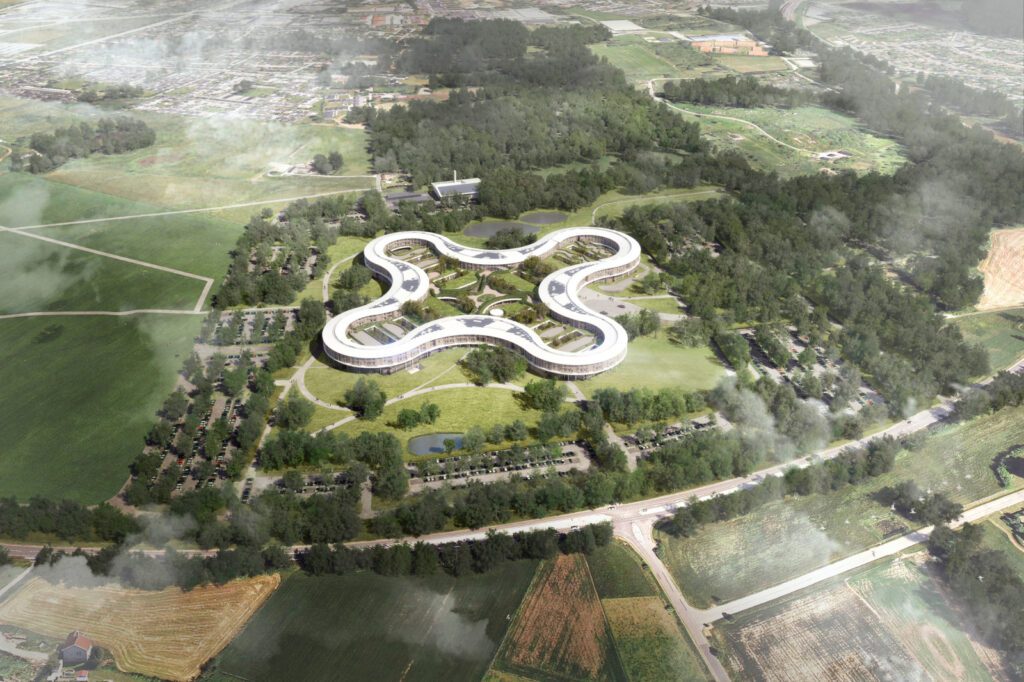
New North Zealand Hospital, Hillerød, Denmark. Herzog & de Meuron. © Herzog & de Meuron
Taken together, these developments point to a design philosophy in which resilience means creating environments that can change how they operate, respond to different levels of clinical pressure and continue supporting both patients and staff when circumstances move beyond those originally anticipated.
What does a digitally enabled hospital environment mean for healthcare delivery?
The digitally enabled hospital is often discussed in terms of individual technologies, whether robotics, AI, real-time location systems or remote consultation platforms. For Fenton, their integration with hospital operations and the physical environment matters most. Digital capability is now embedded in clinical care, patient flow and the coordination of services, and that is changing what healthcare infrastructure must support. As Fenton argues,
The NHS NHP and H2.0 have shown that hospital design should not stand still; they must, and will, take advantage of the digital revolution
That shift is well underway. Since the pandemic, healthcare organisations have accelerated the adoption of technologies that can reduce unnecessary contact and improve operational coordination. Examples include touchless systems, automated logistics, digital patient flow platforms, and telemedicine-ready consultation spaces.
The implication for estates and facilities teams is significant. Building management systems, computer-aided facilities management platforms and connected sensors are already familiar parts of the healthcare estate. The challenge now is to ensure they can support greater integration between building systems and operational platforms, not allowing each to develop as a separate layer.
This also has implications for how healthcare environments are planned before they are built. Building Information Modelling (BIM) and digital twins can provide increasingly detailed representations of the physical estate, creating opportunities to test how buildings may perform under different operational conditions. As these capabilities develop, healthcare organisations could use them to explore patient flows, capacity requirements, asset performance and operational scenarios before committing to physical changes.
Like the physical estate itself, digital infrastructure must therefore be capable of evolving. Hospitals commissioned today will operate for decades, while the technologies supporting healthcare delivery will change considerably. Their design must account from the outset for data architecture, connectivity, engineering systems and the physical provision needed for future technology.
For the NHS, this is particularly important within the New Hospital Programme and Hospital 2.0. designing around the technologies available today risks creating environments that become constrained as models of care evolve.
Installing new technology, however, does not capture the full opportunity. A digitally enabled hospital is one in which the physical estate, clinical systems and operational technologies are designed to evolve together. That integration ultimately depends on what happens next: turning the information generated by those systems into better decisions about how healthcare services and estates are operated. As noted in FORTIS’ discussion of turning digital transformation into real operational value, the value of connected systems lies in how effectively the resulting data informs day-to-day decisions.
How can healthcare estates use data to improve building performance?
Many healthcare organisations still monitor building performance, maintenance, energy, security, workforce coordination and asset condition through separate systems, making it harder to see how estate issues affect clinical and operational performance. A hospital Estates and Facilities Management Control Centre (EFMCC), often referred to as a ‘Flight Deck’, addresses this by bringing data from building automation, security, energy management, maintenance scheduling, robot tracking and staff safety systems into one operational environment. The wider coverage can expose links between engineering faults, interventions, access, service availability and patient flow, supporting earlier risk identification, predictive maintenance and coordination around clinical priorities. Its value, however, depends on clear governance, escalation routes and staff able to interpret the data and coordinate action across estates, facilities, digital, operational and clinical teams.
Why does shifting care from acute hospitals to community settings matter?
Shifting more care into community settings matters because acute hospitals cannot sustainably absorb the growing demand associated with chronic disease, frailty and multiple conditions. Hospital design and digital infrastructure remain central to healthcare transformation, but their impact will be limited unless patients can also access appropriate prevention, diagnostics, long-term condition management and multidisciplinary support outside hospital.
The New Hospital Programme, longer-term capital investment and additional attention to backlog maintenance will all play an important role in strengthening the NHS estate. Even substantial investment in acute infrastructure, however, will not resolve every capacity problem if increasing demand continues to flow towards hospitals that are already under significant pressure. The future healthcare environment therefore needs to include a stronger physical and operational infrastructure for care delivered outside acute settings.
This forms part of the rationale behind the government’s Neighbourhood Health Framework and the planned development of Neighbourhood Health Centres. The intention is to bring primary care, community services, mental health support, public health interventions and social care closer together around the populations they serve, while enabling more care to be delivered closer to home.
Once more, international experience provides useful points of comparison. Ireland’s Sláintecare reforms have included the development of Community Healthcare Networks that bring together general practice, community nursing, allied health professionals and social care teams around defined geographical populations. Denmark has pursued a longer-term shift in the balance between acute and community care, supported by investment in municipal health services, rehabilitation, chronic disease management and care delivered closer to people’s homes. Finland and Norway have also developed models that bring primary care, mental health, social care and preventive services together within more integrated local settings.
The Danish experience is particularly important to Fenton’s argument because the change was not achieved through infrastructure alone; long-term investment was accompanied by sustained political commitment and changes to the roles and ways of working of healthcare professionals.
Those models, of course, cannot simply be transferred to the UK. Health systems operate within different structures, funding arrangements and political contexts. Their experience does, however, underline the importance of aligning infrastructure investment with a clear model of care. If more services are expected to move into community settings, those settings need the appropriate buildings, technology, workforce and supporting infrastructure to take on that activity.
For that reason, Neighbourhood Health Centres must be regarded as part of a wider approach to managing demand across the healthcare system. Acute hospitals will continue to provide essential specialist and complex care, while community infrastructure takes a greater role in prevention, chronic disease management, diagnostics and multidisciplinary support.
What must the UK healthcare environment do differently?
In essence, the pandemic and the increased levels of activity experienced across the globe did not just expose the vulnerabilities in healthcare systems. It also proved to be the catalyst in accelerating the transformation in future healthcare provision as we know it
That is how Fenton sees the most important lesson for the UK: the pandemic was an impetus to rethink how healthcare infrastructure is planned, designed and operated.
Viewed alongside accelerating digital capability and the shift towards community-based care, the case for a fundamentally different approach becomes difficult to ignore. The NHS can no longer treat hospitals as static environments designed around fixed clinical assumptions.
Future acute hospitals will remain essential centres for specialist and complex care, but their design will need to support greater adaptability, stronger infection resilience and more sophisticated digital infrastructure. Future investment provides an opportunity to build that flexibility into clinical spaces, engineering systems and the wider hospital campus from the outset.
Digital capability will be equally important, particularly where it connects information about clinical activity, infrastructure performance and asset management. Its value will depend not only on sensors and software, but also on whether organisations develop the skills and operating models required to use that information effectively.
The same applies to community-based care. A sustainable healthcare environment requires investment across the system, with community facilities capable of supporting prevention, diagnostics, long-term condition management and multidisciplinary care closer to where people live.
International examples demonstrate that progress is possible when infrastructure, policy and models of care are developed with a shared direction. While the UK does not need to replicate another country’s approach, it can learn from the experience of systems that have already confronted similar pressures. The most useful lesson may be that hospital design, digital infrastructure and community capacity cannot be planned as separate issues, as each affects the ability of the others to support the delivery of care.
The NHS must therefore broaden its horizons, using the current period of investment to create a healthcare environment capable of adapting to changing population needs, supporting the workforce, managing increasingly complex infrastructure and providing care in the settings where it can be delivered most effectively. That will require long-term thinking and a clearer connection between the infrastructure being created today and the healthcare system it will support for decades to come.